Concept
Digital Marketplace
Jump To
Problem
California has many tools to help inform policy and help with planning for infrastructure and business development. However, they all used different baseline assumptions on vegetation and explored unique aspects of wood utilization, making it unclear how to operationalize their function(s).
Despite its abundance, low cost and widespread utility, waste biomass remains largely inaccessible. The supply chain for biomass is not well established, and many challenges exist for customers looking to locate, let alone use this abundant resource. Simply locating this material is a challenge, and locating this material quickly and repeatedly in new locations is important to scale the Bioeconomy. Several useful applications, tools, or software products have been developed to support business development, policy, and landscape strategy for wood utilization in California. Generally, the tools either attempted to encapsulate the supply chain in such a way to expedite site feasibility studies or otherwise improve confidence in material characterization. However, it was uncommon to hear of economic development agencies or new businesses relying on these tools to support planning efforts.
Reports & Resources
- SIG-Ascent NEPA and CEQA permitted landscapes dashboard
- SIG-Ascent NEPA and CEQA WebApp
- SIG-Ascent NEPA and CEQA Map Guide
- CA Working Forest Planner
- CA Forest Industry Directory
- UC Davis FRREDSS model
- Schatz Energy Research Center C-BREC model
Strategy
Create one easy-to-use platform that brings together tools and data on biomass and wood products in California. This platform has many functions, including: feedstock forecasting, connecting small non-industrial landowners with forestry professionals, increasing awareness of local contractors and buyers for fiber, and improving data sharing on market-level information of local fiber supply chains for new business development.
The platform aims to reduce friction and enable more effective decision-making along the supply chain. Balanced across three tools, and one web interface, the Marketplace strives to:
- Improve market intelligence for new and existing businesses managing supply
- Bring awareness to key players in the supply chain
- Enable better communication between landowners and licensed professionals, and
- Validate the biomass chain of custody to increase value and ensure compliance in market incentive programs
In Depth Concept Explanation
The Digital Marketplace was originally conceived as a platform to harmonize biomass utilization tools and data across the state, creating a single environment for market intelligence and operational planning that could be scaled to a regional level. Early ideas intended the Marketplace to be an online biomass transaction platform and support real-time updates of offtaking facilities accepting material. In this early version, the Marketplace would then be able to support new public-private partnerships (see Entity Formation) tasked with developing long-term feedstock contracts, thereby enabling new business development.
The Marketplace has since moved away from brokering material and refocused its service-offering toward its current configuration described below. This required the pre-existing tools to be enhanced with several new web interfaces that help operationalize features. While integrating all tools into a cohesive environment is ongoing, their combined utility is being tested today.
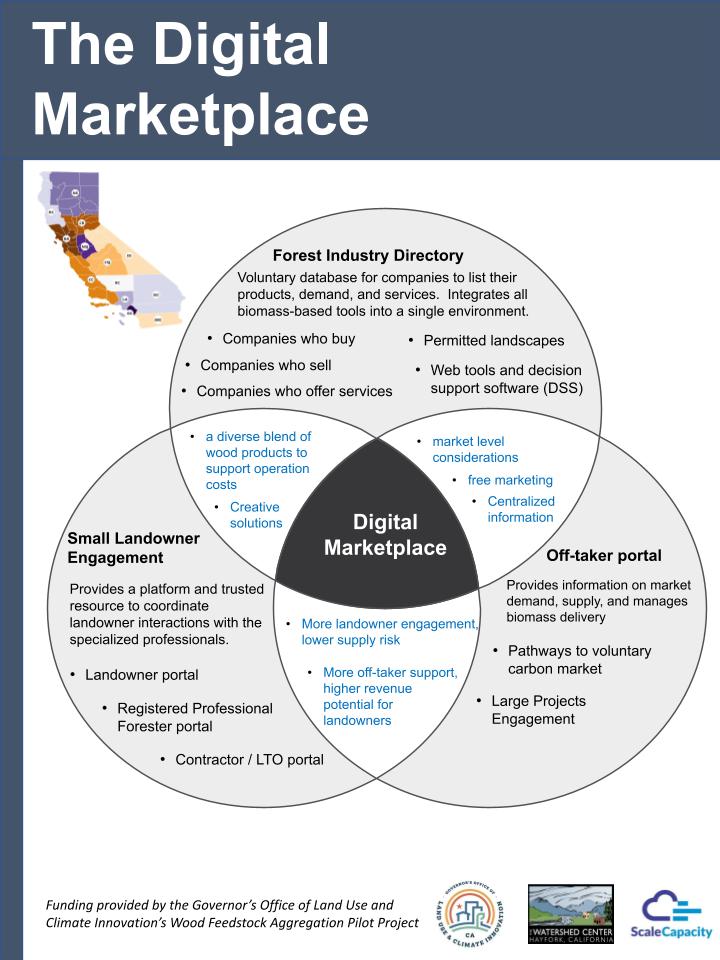
California Working Forest Planner
Lead: LCI and WRTC
Audience: Small private landowners, licensed forestry professional, regional planners
Goal: To support the small, non-industrial forest planning and implementation process by facilitating data, resources, and communication sharing between the landowner, Registered Professional Foresters (RPF), and vegetation contractors.
Overview: Complementing the UCANR small landowner Forest Stewardship Workshops to introduce new landowners to the basics of managing their land, this tool offers: step-by-step process for landowners to engage RPF; a custom analysis of property based on address/APN compatible with cost-share programs; the ability to share GPS points, lines, polygons, and images important for management planning; and the ability to Initiate, or cultivate, a management history digital archive. There is a portal for landowners and a portal for Registered Professional Foresters (RPF) to manage both sides of the interaction. RPFs will have access to post-treatment metrics such as stand density index based on 10 different harvest intensity scenarios based on C-BREC modeling.
California Forest Industry Directory
Lead: LCI and WRTC
Audience: Entrepreneurs, practitioners, regional planners
Goal: Build awareness and foster local business connections, similar to Oregon’s Forest Industry Directory
Overview: Created to complement the UCANR Forest Products and Biomass Power Plant Dataset, the CFID is a comprehensive directory showcasing businesses in the forest industry. From portable sawmills and chippers to flooring manufacturers and urban wood reuse centers, the Directory provides an interactive map and searchable listing of over 180 products, services, equipment options to sell, buy, or include in your business description. This free and voluntary resource is designed to connect companies with potential clients, partners, and industry professionals.
Lead: Loamist
Audience: Manufacturer and policy teams
Goal: an accessible feedstock availability and siting tool. Loamist’s Explorer has a free tier available to everyone with the ability to quickly assess feedstock availability and transportation costs to any location in the United States.
Biomass Data Validation Tool
Lead: Loamist
Audience: State agency staff, manufacturers
Goal: a verification mechanism to ensure that data along the biomass supply chain meets the highest standards of accuracy and completeness
Overview: The Biomass Data Validation Tool is the application of the Biomass Open Origin Standard for Tracking (BOOST) – a data standard funded by the California Department of Conservation and developed by Carbon Direct to improve interoperability between existing tracing platforms within the forest sector. The validation tool will automate what are currently labor-intensive verification tasks, using both rules-based checks and AI-assisted credibility scoring to flag anomalies before they become compliance issues. The tool is designed to be extended to cap-and-trade compliance, state incentive programs like Low Carbon Fuel Standard, BioRAM, BioMAT; as well as durable wood products, and other emerging programs without re-engineering the system. This concept represents the Marketplace’s efforts validate the biomass chain of custody to increase value and ensure compliance in market incentive programs
Lead: Spatial Informatics Group and Ascent Environmental, Inc.
Audience: Regional planners, analysts, contractors
Goal: Develop a spatial interface of permitting status of projects across public and private lands in California in order to enhance biomass supply forecasting
Overview: Accurate biomass supply estimates need to be constrained by operational feasibility. In addition to constraining feasibility by topography, distance from road, and ownership; a biomass producing project must be permitted. Due to the amount of time it takes for permitting to be completed, this can significantly impair consistent forecasting of biomass supply. The spatial interface attempts to correct this issue by providing supply managers an understanding on the status of permitted lands, thereby improving supply forecast and feasibility.
Status
The Marketplace is currently being deployed and tested. WRTC has entered into a working agreement with Placer County to accelerate landowner engagement and catalyze forest management of small private parcels through the application of the California Working Forest Plan and California Forest Industry Directory. Partnership conversations are occurring simultaneously and other regions are expressing interest in piloting the Marketplace. Loamist and SIG are working simultaneously on applying the permitting landscape in an effective way to Loamist’s track and trace coordination service offering.
Points of Contact
Governor’s Land Use and Climate Innovation
Michael Maguire, Program manager
michael.maguire@lci.ca.gov
The Watershed Research and Training Center
Clarke Stevenson, Project manager
clarke@thewatershedcenter.com
Consultants
- Calpoly San Luis Obispo – Darren Kraker, Amazon Web Services
- SCALE Capacity – Maulik Naik, Web developer
- Spatial Informatics Group – Jason Moghaddas, NEPA layers
- Ascent Environmental – Curtis Ailing, CEQA layers
- Loamist – Andy Miller, Chain of Custody software
- UC Davis – Dr. Boon-ling Yeo, Principal Investigator for the FRREDSS model
- Calpoly Humboldt – Dr. Kevin Fingerman, Principal Investigator for the C-BREC model