Region One
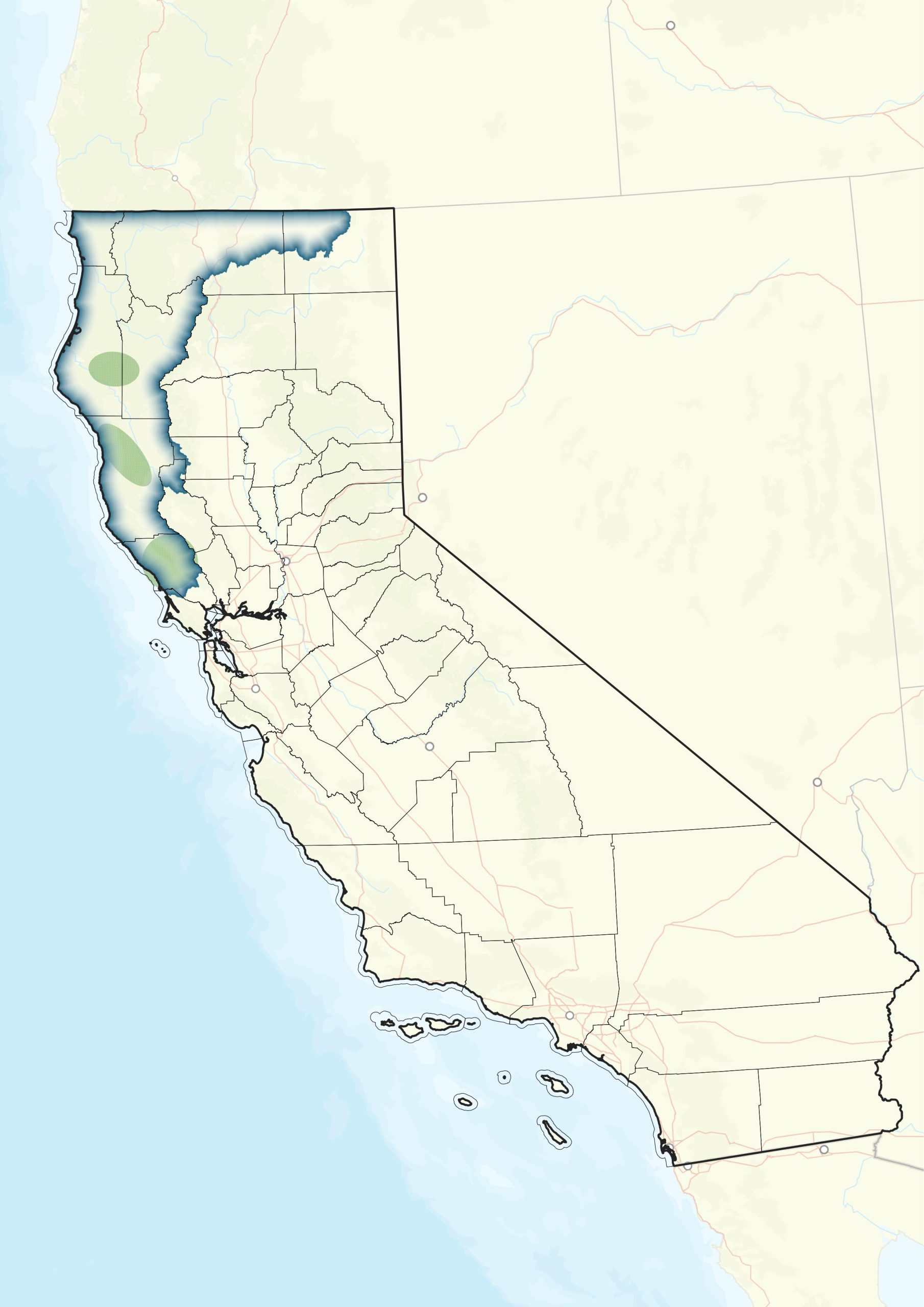
North Coast
Jump To
Point of Contact
The Watershed Research and Training Center
Clarke Stevenson
clarke@thewatershedcenter.com
North Coast Resource Partnership
Karen Gaffney
kgaffney@northcoastresourcepartnership.org
Lead
North Coast Resource Partnership
Established in 2004, NCRP is a successful long-term collaboration among Northern California Tribes, counties, and diverse regional partners. For more information about NCRP, please see the North Coast Resource Partnership story map.
Co-Facilitators
WRTC was formed in the early 1990s as a local project to re-train displaced loggers and millworkers. Today, WRTC is a vibrant nonprofit organization that serves the local communities in Trinity County and leads statewide and national initiatives on all aspects of community-based land stewardship.
The Shasta Valley RCD is a Special District serving central Siskiyou County, California, and fiscal sponsors of the grant.
Mission
Advance statewide program goals by focusing on smaller, community-scale approaches (like forest and wood product cooperatives) to coordinate small-diameter and woody material from non-industrial land management.
The pilot project is part of NCRP’s overall goals as laid out by the Vision for North Coast Resilience. Based on partner feedback, the size and diversity of the seven county region warranted 3 subregion private-public partnership (P3) pilots. The team combined additional funding streams under the Regional Forest and Fire Capacity Program to create the Feedstock Aggregation Project (“North Coast Pilot”), furthering research on how to organize across regions with persistent issues in workforce capacity. The North Coast Pilot advocates for a mixed product pathway for highest, best use of material and explicitly focuses on non-industrial wood sources, as well as small, more nimble entity models like cooperatives to support community scale efforts.
Explore Sub-Regions
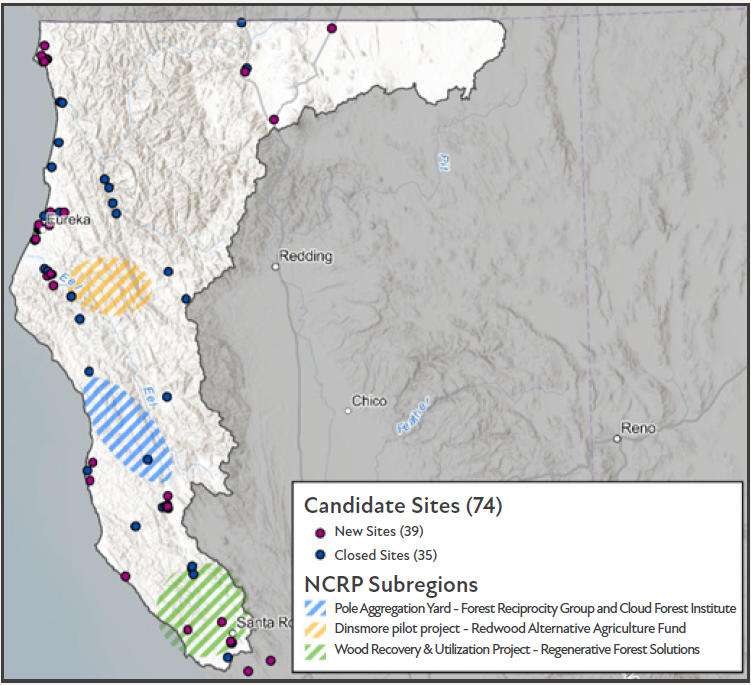
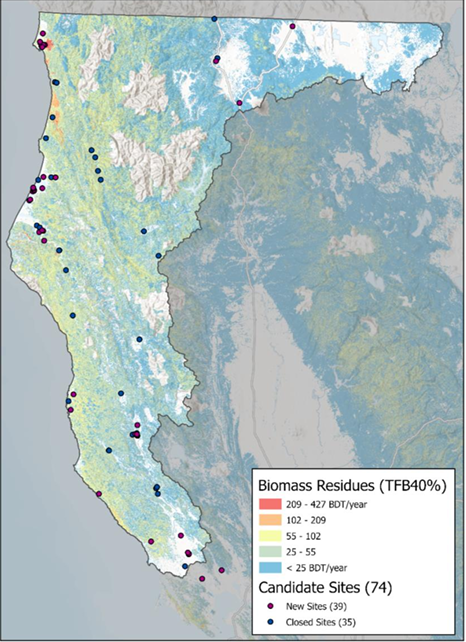
NCRP subregion’s area of interest with Tukman Geospatial suitable locations for siting a wood products campus.
Dinsmore Wood Feedstock Aggregation Pilot
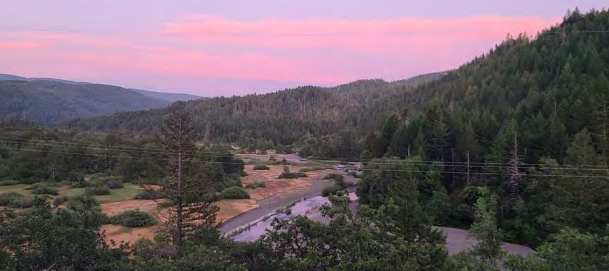
Dinsmore Wood Feedstock Aggregation Pilot
Lead: Redwood Alternative Agriculture Fund (RAAF)
Contact: Mika Cook – mika.wfap@gmail.com or Drew Barber – admin@uplift.coop
Mission: To investigate the viability of a cooperative model for the public good which facilitates the removal, transportation, aggregation, and processing of woody biomass from public and private forest lands in the Eastern Humboldt/Western Trinity regions.
Products/Services: Sort yard. Restoration-based thinning, Post-fire material. Chips, firewood, developing available markets
Mendocino Pole Aggregation Depot
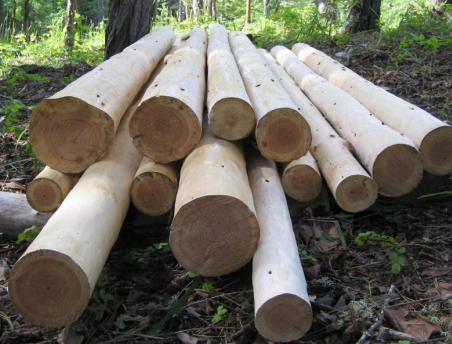
Mendocino Pole Aggregation Depot
Lead: Forest Reciprocity Group (FRG)
Contact: Jen Burnstad, Cloud Forest Institute – jen@forestreciprocity.org
Mission: To investigate what would be needed to establish a local FRG Pole Aggregation Depot (FRG PAD), with a focus on Small Diameter Douglas fir Trees (6”-14”) processed into Structural Round Timber (SRT) for use in housing construction.
Products/Services: Pole Aggregation Depot and service. Structural roundwood pole (4-14in DBH)
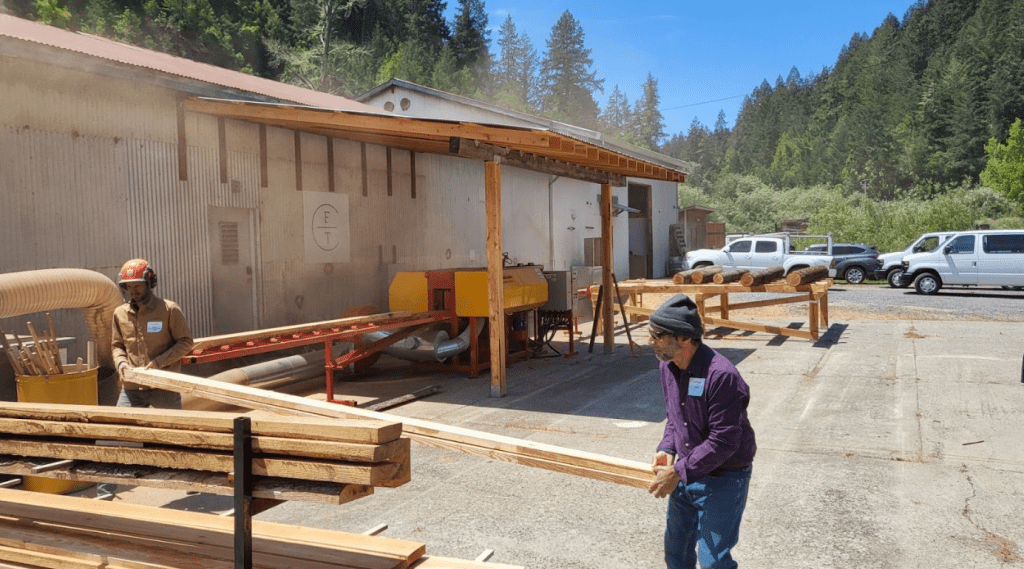
Sonoma County Wood Recovery and Utilization Project
Sonoma County Wood Recovery and Utilization Project
Lead: Regenerative Forest Solutions (RFS)
Contact: Temra Costa, RFS – temra@regenerativeforestsolutions.org
Mission: Convene and align public agencies, landowners, and private partners to establish an ecologically sound and economically viable wood recovery and utilization system that enables forest health treatments, reduces wildfire risk, and strengthens climate and economic resilience in Sonoma County and the greater Bay Area.
Products/Services: Woody biomass recovery and management; Development and implementation of local wood processing and utilization infrastructure; Market development for climate-beneficial wood products; Education, technical assistance, and workforce engagement; Coalition building and cross-sector coordination to align policy, funding, and implementation.
Key Takeaways
The North Coast has a complicated history with wood utilization stemming from the Timber Wars of the 1990s. Due to the spectrum of values across NCRP’s landscape, place-based strategies were the best way to advance difficult conversations on the topic. Furthermore, in these low-capacity regions, cooperative models were investigated but ultimately deemed too risky without a strong financial incentive to participate. All 3 subregion pilots identified the highest, best use of wood from non-industrial lands for a local circular economy.
Key takeaways include:
- Cooperatives are not as attractive as expected. Motivating factors for cooperatives are either (1) the financial incentive to participate or (2) the ability to provide a service that does not have a formal process already established. Because the material is inherently low value, there is no simple financial incentive to form a cooperative when a nonprofit could achieve the same ends.
- RFS and FRG have both developed a comprehensive product and marketing strategy to support local supply chains. They have been able to leverage this funding for additional fundraising
- Work in the Dinsmore region of Humboldt County by RAAF has led to the area’s first CALFIRE forest health grant which will begin a landscape scale management strategy to support non-industrial landowners.
Challenges
- With an emphasis on producing the highest, best use of wood material, market demand remains a key challenge across all regions in a globalized economy. There are parts of the region with no existing markets for wood products. This situation requires markets to be created, for both bioenergy and wood products, alongside the aggregation of supply and the creation of products.
- Financing for new wood products businesses and lack of grant availability for needed coordination activities is preventing expansion of private and public sector capacity.
- Procuring wood from non-industrial forest management can be tricky. For places like Sonoma County which has small, parcelized private lands, the ability to commercially sell logs to wood product companies may be restricted depending on the type of permitting used.
Next Steps
To reach a broader market, the subregions must focus on two critical needs: building demand across multiple product pathways and securing sufficient capital. Without a robust marketing effort that highlights climate-smart forestry values, or a more balanced public investment strategy for necessary infrastructure, large-scale biomass utilization will likely remain the sector’s primary challenge
Status
Financing for new wood products businesses and lack of grant availability for needed coordination activities is preventing expansion of private and public sector capacity.
Team Members
Core Team
- NCRP: Karen Gaffney, oversight and strategy, Rose Roberts, technical writing and content development.
- WRTC: Clarke Stevenson, Martin Twer, Nick Goulette. Program management, facilitation, and technical assistance
- Tukman Geospatial: Regional assessments
- Regenerative Forest Solutions: Temra Costa. Subregion management
- Forest Reciprocity Group: Jen Burnstad, Eric Lassovitch, Bodhi Harnish, Matilda Miyares, Govinda Dalton, Chuck Payne. Subregion management
- Dinsmore WFAP: Mika Cook, Drew Barber. Subregion management
Consultants to WRTC
- The Beck Group. Wood product technologies assessment
- Conservation Innovations Group. Program coordination